“When you help a woman fulfil her potential, magic happens,” Sara Blakely.
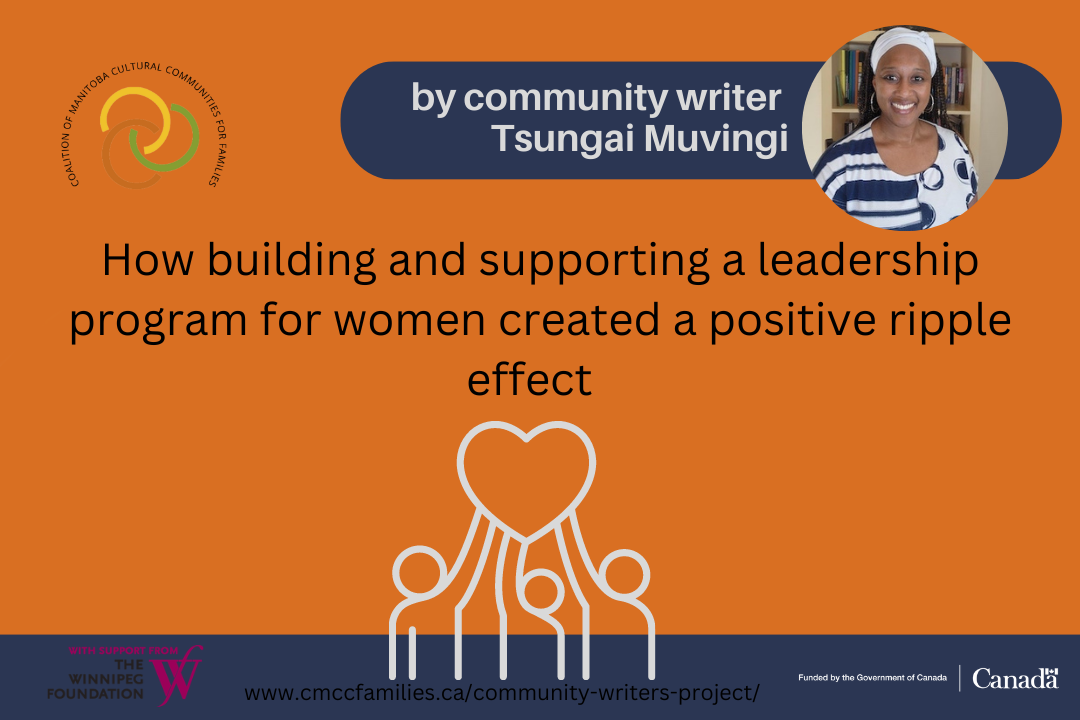
Six weeks, five women, three facilitators, food, and conversations. That is the recipe and foundation that has begun a ripple effect in three cultural communities. CMCCF’s program entitled Igniting Women for Leadership from Within: From Marginalized to Mobilized was created to help women fulfil their potential and become leaders within their cultural groups and local Winnipeg community which they have chosen to call home.
The women’s leadership program used a hybrid in-person and online approach, engaging facilitators from South Africa, Toronto and Winnipeg with participants having backgrounds from Somalia, Afghanistan and Nigeria. Participants also ranged in age from eighteen to twenty-six and many had been in Canada for less than six months.
Where the magic began:
Bringing together women from various backgrounds for this program started with word of mouth and referrals. Most of the women heard about the program from a friend or someone they knew. Faadumo from Somalia was referred by a friend from the Canadian Muslim Institute, but her decision to participate was because the title of the program intrigued her. She knew she wanted to be a leader and the fact that there was a program focused on helping marginalized women drew her attention.
Ibby from Nigeria had a similar introduction. A friend was reading the title and description and what the program hoped to achieve, and she knew she had to become involved. Sadaf, whose home country is Afghanistan saw an opportunity to build new friendships and develop leadership skills.
Odelia Duffus began as a coordinator for the program having a long history with CMCCF and added the role of instructor as the program progressed because she saw an opportunity to help women dig deeper for the leadership that is naturally within them. She appreciated that it was geared towards marginalized communities and immigrants who have moved to Canada who feel they don’t have a voice, noting that few of the women aren’t allowed to speak in large group settings in their cultural communities.
Perspectives:
“Giving participants the opportunity to speak in their own language resulted in new ideas and creativity. Their confidence levels went up. You could physically see the difference in their confidence and see a glow in their faces and beautiful energy,” Odelia shared.
Concerns around the women not being able to engage due to language barriers going into the program were high, but at the end of it, every woman in the room shared and contributed.
You could feel Faaduma’s appreciation of the program during the interview and during her feedback, this is what she had to say, “The program far exceeded my expectations. I loved how intimate the setting was so we could get to know each other and ourselves.”
For Sadaf, part of her expectation coming into this was to improve her English language skills and to learn about Canadian culture. Her concerns, not really knowing what to expect, were that she had recently moved to a new country, with a new culture and new language.
From the instructor’s perspective, challenges including technology and the 6-week commitment for participants required additional in person support. However, they feel the impact far outweighed the challenges. Everyone bonded on food and conversations and seeing participants learning what their personal values were versus what was prescribed by community, was powerful.
Impact
“I alone cannot change the world, but I can cast a stone across the water to create many ripples.”
– Mother Teresa
After the session on personal values, Faaduma went home and called all of her family and had them also work on their personal values together as a family. In addition, because of how compassionated the facilitators were, Faaduma is excited to take this perspective and the values she has learned to bring more understanding and respect between people within and outside of different cultures.
“Thank you. I have learned a lot from this. Coming into this I didn’t know what I was getting into, but it turned into a positive learning experience. I am going to leave knowing better and having built new friendships,” Faaduma.
Sadaf, like many immigrants, found it difficult having to restart life from zero. She moved to Winnipeg with her mum and sister but had to leave behind her father and husband. Participating in the sessions despite language barriers helped her to start building a supportive community to adapt to life in Canada.
Sadaf intends to use the new skills she learned to build bridges with others and to embrace Canadian culture.
The women were able to build their own supportive network out of this program. They also started and grew their own businesses and are still connected even after the program ended.
A positive ripple effect can already be felt. Everyone involved hopes that more women have the opportunity to share in this amazing experience; and that future iterations will include more activities such as art, song, dance, writing, etc. so that regardless of background and language, everyone finds their unique way to be engaged.
This article was written by community writer Tsungai Muvingi as part of our J.E.D.I. Initiative – Community Writers Project. All thoughts and opinions expressed are Tsungai’s own. You can learn more about Tsungai on our team page here.
To learn more about our Intercultural and Intergenerational Diversity and Inclusion Engagement Project, go to our J.E.D.I. Initiative landing page here.
After years of dedicated leadership, our Director Martin will be stepping down as CMCCF enters an exciting new chapter. We are deeply grateful for everything he has brought to the Coalition of Manitoba Cultural Communities for Families, and we look forward to what lies ahead together.
As we navigate this transition, we welcome your questions, thoughts, and support. For any inquiries, please reach out to Florence at floxy166@yahoo.ca — she will be happy to hear from you.
Thank you for being part of our community.
Before You Download:
Please enter some information.
Purpose
The Purpose of These Peace-First: CollaborationNet Pages
These pages exist to share what we have learned.
Over the past year, Peace-First: CollaborationNet has operated as a time-limited demonstration initiative, which is a space to test ideas, host conversations, and discover what might grow when peace is placed at the center.
Conversations took root in informal Peace-First Hubs across Winnipeg, Thompson, Brandon, and Portage la Prairie, with related gatherings in Vancouver and Toronto. Toronto now helps convene national roundtable conversations, linking local dialogue with a broader Canadian exchange.
What began as small, local discussions has become more connected — not through expansion or centralization, but through coherence. Across regions, shared themes, tensions, and hopes are emerging.
This webpage documents that journey. It gathers reflections, materials, and learning from Hub conversations so others can understand what has been explored and carry it forward.
From the beginning, Peace-First was designed as a seed-planting initiative, formally concluding March 31, 2026. Its focus has been to explore how individuals and cultural communities understand inner peace, collective vision, community cohesion, and cultural dignity and visibility.
The Hubs are volunteer-led spaces where community connectors and members gather to listen, reflect, and imagine what a peaceful geographic and cultural community might look like in practice.
Along the way, we developed background papers, reflection documents, and practical toolkits shaped by lived experience in Manitoba and beyond. This page now serves as a living repository within the Peace-First Library, offering capacity-building tools, framing papers, hub guidance, and shared learning that communities can adapt to their own realities.
The purpose is not to centralize authority, but to make learning accessible.
Peace-First Hubs are community-led and partner-supported — grounded in relationship, not hierarchy. Supported by ACOMI, ECCM, Palaver Hut, MIA, cultural community members across the country, and allies such as MANSO, Mediation Services, CanU Canada, and PCHS, this work moves through partnership rather than control.
This initiative has been made possible through the principal financial support of the Department of Canadian Heritage, with a supportive role played by The Winnipeg Foundation. Their investment has allowed these conversations, materials, and connections to take shape.
These materials are not instructions to replicate. They are tools to adapt.
This page is more than documentation. It is an invitation.
Peace-First is not about imposing a uniform model. It is about strengthening conditions for dialogue, cohesion, and shared responsibility before a crisis.
If this resonates, we invite you to explore further, join a national roundtable call, or consider what it would mean to host or support a conversation in your own community. Join a national roundtable call. Complete the survey.
The seeds have been planted. What grows next depends on all of us.




 Previous Post
 Next Post