June 27, 2026 By Alka Kumar (Toronto)
As an educator in the classroom, or as a facilitator leading workshops and community conversations, I have always tried to follow one simple principle.
Whenever I ask participants to engage in an activity, I participate in it too.
The Fairness Principle as a Way of Developing Peace Thinking
Over the years, I have found that this practice serves two important purposes.
First, it allows me to experience the activity myself. I learn what it feels like, how challenging it may be, and whether I am asking something of others that I would not be willing—or able—to do myself. To me, that would not be fair. As facilitators and educators, we should never ask participants to step into vulnerability unless we are prepared to do the same.
Equally important, many people enter workshops feeling hesitant or uncertain about speaking openly in front of others. By sharing first, we model the kind of openness we hope to invite. In doing so, we make it a little easier for others to step outside their comfort zone.
Second, this practice helps disrupt the traditional power dynamics that often exist within teaching and learning environments. Too often, the relationship between teacher and student, facilitator and participant, unconsciously reinforces hierarchy. By participating alongside everyone else, we begin creating a more equal learning space where every voice has equal value.
In many ways, I have come to see this as a small but meaningful practice of peacebuilding.
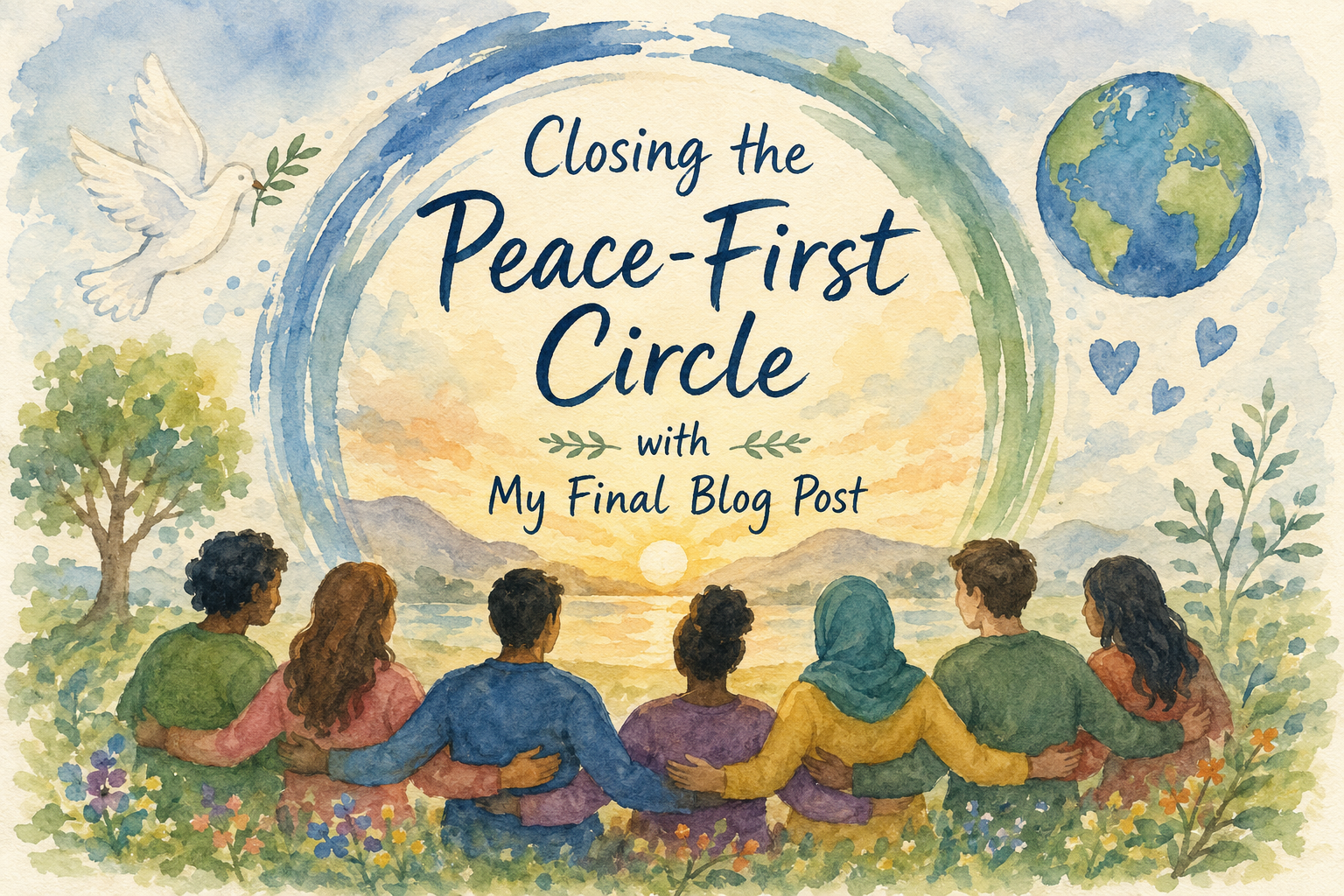
And so, as we close this Peace-First journey together, it feels only appropriate that I follow the same principle one final time.
Having invited so many others to reflect on what peace means to them, I would now like to share some of my own reflections with you.
Some Personal Thoughts About Peace
My understanding of peace begins with creating spaces that feel as safe, welcoming, and equal as possible.
Whether we are leading, facilitating, teaching, parenting, working alongside colleagues, or simply participating in community life, I believe we should continually ask ourselves:
Do the people around me feel safe enough to speak?
Do they believe their voice matters?
When people experience psychological safety, they are more likely to discover their voice, share their stories, contribute their ideas, and participate fully in shaping the communities around them.
For me, peace begins there.
Thinking from an Equality Principle
The only way I know how to think consistently from a place of equality is to genuinely believe that every human being possesses equal worth and equal dignity.
This does not mean I always succeed.
Far from it.
Like everyone else, I continue learning, reflecting, correcting myself, and growing.
But this remains my North Star—a mindset, an attitude, and a way of living that I continually aspire toward.
I have also learned not to become discouraged when I encounter individuals or systems that do not yet operate from this fairness principle.
Instead, perhaps our role is simply to model another way.
Peace advocacy is often less about persuading others and more about quietly demonstrating what fairness, humility, and compassion can look like in everyday life.
A Level Playing Field for Everyone
In my humble opinion, living according to this guiding principle requires us to remind ourselves, again and again, that the playing field should be level for everyone.
Every person deserves equal opportunity.
Every person deserves access to resources.
Every person deserves dignity.
Every person deserves to be treated fully as human.
Whenever we find ourselves in positions of influence—whether in families, organizations, communities, classrooms, or governments—we have an opportunity and a responsibility to apply this fairness principle in the decisions we make.
Living this way has gradually made me less judgmental—or perhaps more accurately, more aware of my own judgments.
When I notice myself making assumptions, I try to pause.
I ask myself whether I am truly living the values I claim to believe.
This ongoing self-reflection has also made me more sensitive to the many ways “othering” occurs within our societies.
We see it in prejudice.
We see it in racism.
We see it in exclusionary policies.
We see it in negative narratives directed toward migrants, refugees, newcomers, asylum seekers, indigenous communities, and many other marginalized communities.
Are these not all forces that make our world less equal—and ultimately, less peaceful?
We Need More Empathy, Compassion, and Humanity
The fairness principle naturally leads us toward empathy.
It invites compassion.
It reminds us of our shared humanity.
Perhaps one way of expressing this simply is to treat strangers as neighbours, and to care for our neighbours as we would care for our friends.
When we genuinely begin seeing one another through this lens, prejudice becomes more difficult to sustain.
Discrimination becomes harder to justify.
Marginalization becomes more visible.
The labels that separate us gradually lose their power because we no longer see others as somehow less worthy than ourselves.
Peace, then, is not simply an outcome.
It becomes a way of seeing.
Conflict Transformation: A Different Way of Building Peace
As I reflect on this Peace-First journey, I often return to one of the ideas that most influenced me during my doctoral studies in Peace and Conflict Studies.
Among the many theories I encountered, the concept of Conflict Transformation, developed by John Paul Lederach, continues to resonate deeply with me.
Unlike conflict management or conflict resolution—which often focus on reducing tension or solving an immediate problem—conflict transformation asks us to go much deeper.
It challenges us to understand the underlying relationships, histories, structures, and patterns that gave rise to the conflict in the first place.
Rather than simply ending conflict, it seeks to transform the conditions that created it.
The more I explored this idea, the more I realized how often conflict is sustained by unequal power relationships.
Whether between individuals, communities, institutions, or nations, conflict frequently emerges when one party holds—or exercises—greater power than another, or believes itself to be superior.
If these power imbalances could be addressed more honestly and more equitably, many conflicts might begin to dissolve before they escalate.
This realization fascinated me.
It also humbled me.
Because I came to understand that power dynamics are woven into almost every human relationship.
Transforming conflict, therefore, is never easy.
Walking the Journey Together
Yet there was also hope in that realization.
While I cannot transform every system, every institution, or every conflict, I can begin with myself.
I can pay attention to how I use power.
I can choose fairness over privilege.
I can choose curiosity over judgment.
I can choose dialogue over division.
I can choose compassion over indifference.
Perhaps that is where peace begins.
Not with changing the whole world overnight, but with changing how we show up in the relationships immediately around us.
And perhaps, if enough of us choose to walk that path together, those small acts of peace become something much larger.
A Final Goodbye
As I sign off from this Peace-First journey, I do so with deep gratitude.
Thank you for reading these reflections.
Thank you to every participant, colleague, partner, and friend who helped shape these conversations over the past several years.
It has truly been a privilege to learn alongside you.
As you continue your own journey, may life offer you many unexpected gifts.
May you receive them with gratitude.
May you share them generously with strangers.
And may you continue creating small spaces of fairness, compassion, courage, and hope wherever life takes you.
Wishing each of you a peaceful, joyful, and restorative summer.

 Previous Post
 Next Post