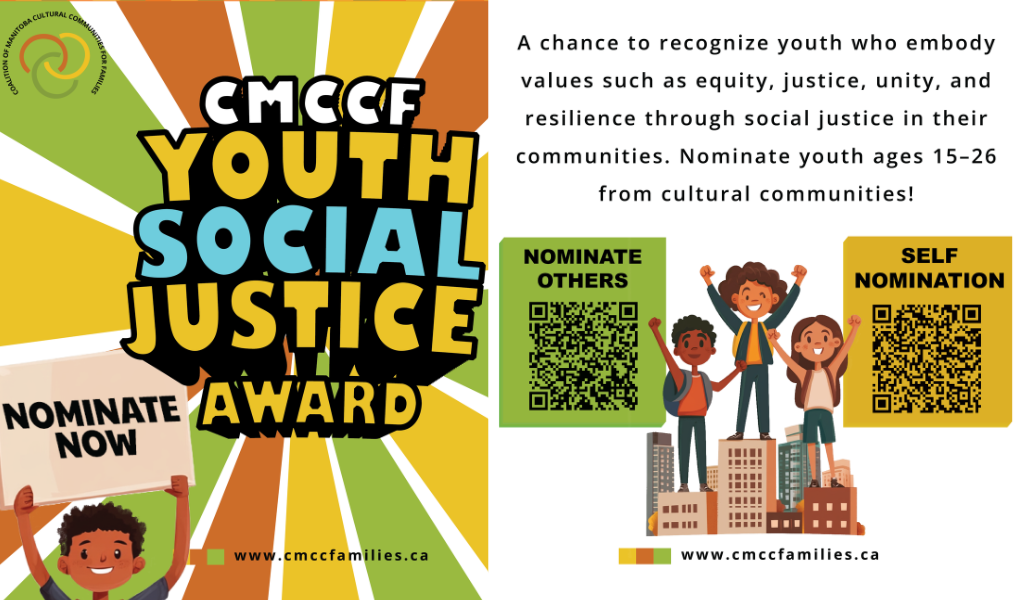
The CMCCF Social Justice Youth Award will be granted to an individual or a group who is making positive change for communities, either local or beyond!
Our award celebrates the remarkable achievements of young people between the ages of 15 and 26 from diverse cultural backgrounds who are leading with bravery, curiosity, intelligence, and empathy.
We wish to recognize those who are making small, incremental, and often invisible changes in areas that matter to them, such as arts, culture, faith, and community, while also creating safe and comfortable spaces within their own cultural communities.
These young leaders are deeply committed to social justice and community building, and are creating more equitable, diverse, and inclusive communities where everyone feels a sense of belonging. They are not just creating change in their communities but also within their own families, with their friends and neighbors, and in new cultural communities.
We believe that by recognizing and celebrating these young people, we can inspire others to get involved in creating positive change in their own communities, and to build a better world for all, not through government or institutions, but through the power of families and cultural communities.
Have you contributed to Social Justice in your community?
Social justice is a complex and multifaceted concept that involves addressing power imbalances and works towards a more equitable distribution of resources and opportunities for all individuals and communities. It is important to understand that social justice is not just about creating equal opportunities, but also about recognizing and addressing the ways in which systems and structures may perpetuate oppression and marginalization.
Though complex and difficult, it is important to acknowledge that everyone has a role to play in working towards social justice. It requires critical self-reflection and a willingness to learn and grow. It also involves being open to hearing and understanding the perspectives of marginalized communities, and acting to make changes in one’s own life and in the broader community.
It’s also important to recognize that social justice is not a one-time event, but a constant work in progress, and it’s ongoing. It’s a process that requires individuals and communities to continuously reflect, learn, and adapt in order to create a more just and equitable society.
When do I need to submit the expression of interest form?
This is a quick nomination process.
Our cut-off date is February 11th at 4:00pm CST
The successful nominee will be announced online on March 10th, 2025.
We thank all who have applied and value your efforts!
Why should I nominate an individual or a group?
This is a great opportunity for youth to be recognized for their contributions in making change within communities which ultimately impact the world! The award recipient will be granted with recognition by cultural communities in Manitoba, a CMCCF podcast interview, and access to a mentor for their further growth and development.
Who can nominate?
We invite you to nominate yourself, or an individual or a group.
The attributes we are looking for are (but not limited to):
1. Must be between the ages of 15-26.
Desire to change local communities/ the world: The individual/group must be motivated to make a positive impact on local communities and the world. They must have a clear vision of how they want to achieve this goal.
Commitment to Social Justice: The individual/group must be dedicated to promoting social justice and advancing the cause of equity, diversity, and
Community Building: The individual/group must be actively engaged in building strong and inclusive communities, and must have a track record of working collaboratively with others towards this goal.
Leadership: The individual/group must demonstrate their ability to take initiative, be an active listener, open to learning, teaching, and involving
How to apply?
We have an online expression of interest form, which will have a number of questions for the nominee to answer. Also, there will be a section for the nominee to provide more information about how they believe that they have met the attributes and answered the question of ‘how have the person nominated contributed to social justice in the community?’
After years of dedicated leadership, our Director Martin will be stepping down as CMCCF enters an exciting new chapter. We are deeply grateful for everything he has brought to the Coalition of Manitoba Cultural Communities for Families, and we look forward to what lies ahead together.
As we navigate this transition, we welcome your questions, thoughts, and support. For any inquiries, please reach out to Florence at floxy166@yahoo.ca — she will be happy to hear from you.
Thank you for being part of our community.
Before You Download:
Please enter some information.
Purpose
The Purpose of These Peace-First: CollaborationNet Pages
These pages exist to share what we have learned.
Over the past year, Peace-First: CollaborationNet has operated as a time-limited demonstration initiative, which is a space to test ideas, host conversations, and discover what might grow when peace is placed at the center.
Conversations took root in informal Peace-First Hubs across Winnipeg, Thompson, Brandon, and Portage la Prairie, with related gatherings in Vancouver and Toronto. Toronto now helps convene national roundtable conversations, linking local dialogue with a broader Canadian exchange.
What began as small, local discussions has become more connected — not through expansion or centralization, but through coherence. Across regions, shared themes, tensions, and hopes are emerging.
This webpage documents that journey. It gathers reflections, materials, and learning from Hub conversations so others can understand what has been explored and carry it forward.
From the beginning, Peace-First was designed as a seed-planting initiative, formally concluding March 31, 2026. Its focus has been to explore how individuals and cultural communities understand inner peace, collective vision, community cohesion, and cultural dignity and visibility.
The Hubs are volunteer-led spaces where community connectors and members gather to listen, reflect, and imagine what a peaceful geographic and cultural community might look like in practice.
Along the way, we developed background papers, reflection documents, and practical toolkits shaped by lived experience in Manitoba and beyond. This page now serves as a living repository within the Peace-First Library, offering capacity-building tools, framing papers, hub guidance, and shared learning that communities can adapt to their own realities.
The purpose is not to centralize authority, but to make learning accessible.
Peace-First Hubs are community-led and partner-supported — grounded in relationship, not hierarchy. Supported by ACOMI, ECCM, Palaver Hut, MIA, cultural community members across the country, and allies such as MANSO, Mediation Services, CanU Canada, and PCHS, this work moves through partnership rather than control.
This initiative has been made possible through the principal financial support of the Department of Canadian Heritage, with a supportive role played by The Winnipeg Foundation. Their investment has allowed these conversations, materials, and connections to take shape.
These materials are not instructions to replicate. They are tools to adapt.
This page is more than documentation. It is an invitation.
Peace-First is not about imposing a uniform model. It is about strengthening conditions for dialogue, cohesion, and shared responsibility before a crisis.
If this resonates, we invite you to explore further, join a national roundtable call, or consider what it would mean to host or support a conversation in your own community. Join a national roundtable call. Complete the survey.
The seeds have been planted. What grows next depends on all of us.


 Previous Post
 Next Post