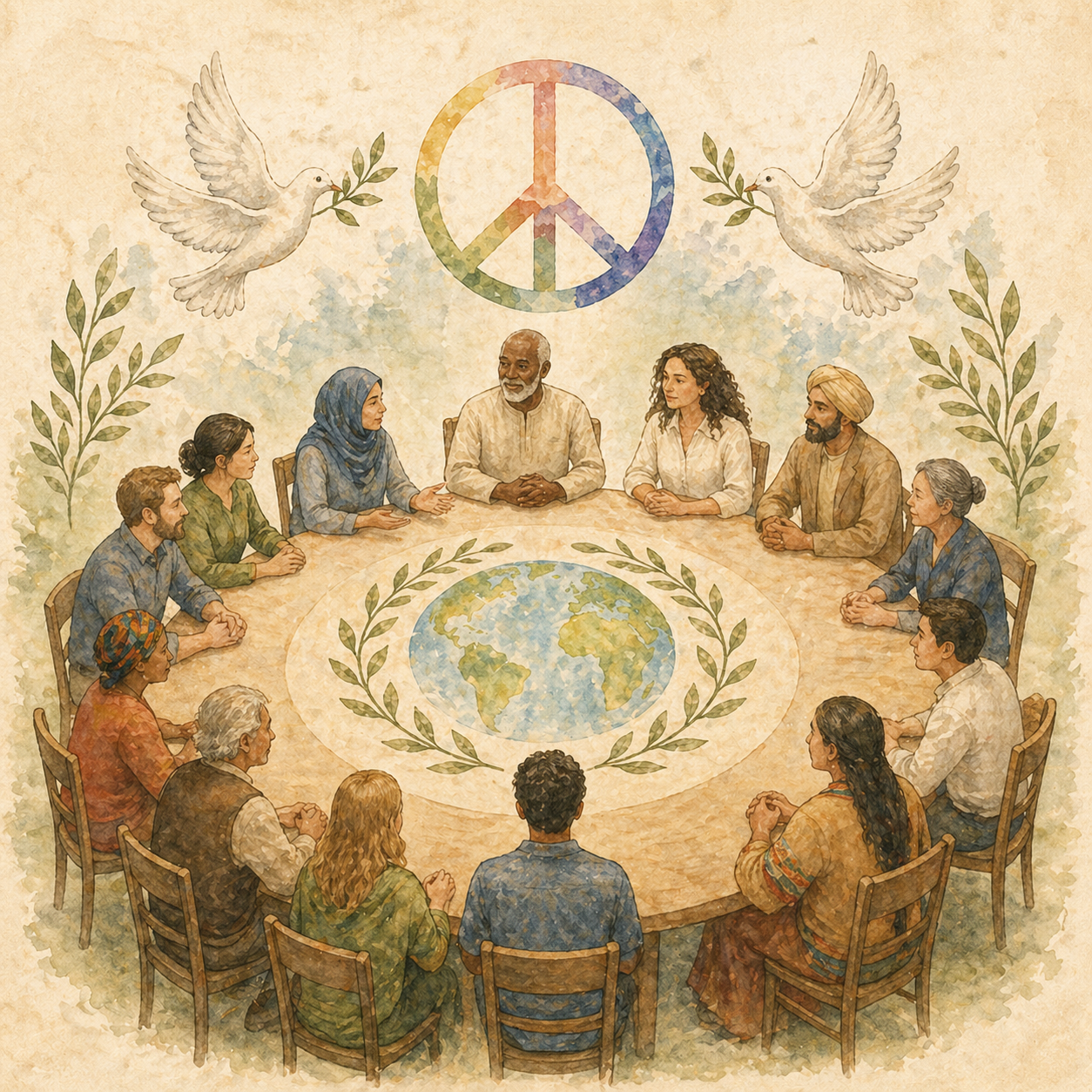
To date, as part of the National Peace Roundtable process in Toronto and the Greater Toronto Area, we have hosted four roundtable conversations over the past several months.
Several blogs and summaries already available on the CMCCF website provide important context, background, and reflections on the origins of Peace-First. This blog post offers a broader recap of the directions these conversations have taken, while highlighting some of the key issues, questions, and themes that participants raised.
Bringing People Together Across Canada
The National Roundtable held on October 27 was hosted in a hybrid format. Nearly twenty participants joined in person at a downtown Toronto location, while approximately fifteen others participated virtually through Zoom.
Virtual participants joined from across Canada, including Vancouver, Halifax, Calgary, Thunder Bay, Regina, and Winnipeg. This national presence enriched the conversation and helped show that questions of peace, belonging, justice, and community are not limited to one city or region.
The Invitation: What Does Peace Mean?
Participants were invited to share their experiences, thoughts, and feelings about peace and peacebuilding. We asked them to reflect on what peace means to them, why it matters, and what a peaceful society might look and feel like.
A wide range of responses emerged. Many participants described peaceful spaces as places where people experience safety, social justice, equal rights, acceptance, dignity, and belonging. Peace was imagined as a society where identities are validated, opinions are valued, and people do not have to shrink or hide parts of themselves in order to be accepted.
The Absence of Peace
Participants also reflected on what the absence of peace feels like.
For some, it was connected to anxiety, social isolation, polarization, communication breakdowns, and the turbulence of living in uncertain times. Social media was raised as one place where these tensions often intensify. Participants noted that online hostility can move beyond disagreement into bullying, aggression, fear, and cycles of harm for those targeted.
Others described the absence of peace in broader structural terms. Poverty, homelessness, unemployment, displacement, racism, and unequal access to resources were all seen as barriers to true peace.
This led to one of the most important questions raised in the conversations:
Can there be peace without justice?
Social Justice as the Foundation of Peace
One theme emerged clearly and repeatedly: social justice is the foundation for peace.
Participants returned often to the idea that without justice, there can be no lasting peace. Peace requires fairness, equity, equal rights, recognition, and dignity—not simply as ideals, but as lived realities for individuals, families, and communities.
Belonging was also central. Participants spoke about the importance of being accepted without having to compromise one’s identity, culture, dignity, or lived experience. This included the safety to be fully oneself as a migrant, refugee, newcomer, asylum seeker, Indigenous person, non-Indigenous person, or as someone living with multiple intersecting identities.
Peace as Relational
Peace was also described as deeply relational.
Some participants connected this to Indigenous perspectives and teachings that understand peace through balance, interconnection, respect, the sacred role of children, and our relationships with land, water, animals, ancestors, and future generations.
This view helped expand the conversation beyond peace as simply the absence of conflict. Instead, peace was understood as something created through relationships, responsibilities, and the way we care for one another and the world around us.
Everyday Peacebuilding
Participants also grounded peacebuilding in everyday life.
One example shared was that meaningful employment for skilled newcomers is peacebuilding. When well-qualified newcomers are unemployed or underemployed for years after arriving in Canada, they may experience deskilling, discouragement, frustration, and loss of well-being. In such circumstances, it becomes difficult to sustain either inner peace or outer peace.
This example showed how peacebuilding is not abstract. It is connected to housing, employment, dignity, recognition, family stability, and the opportunity to contribute fully.
Inner Peace and Outer Peace
Another important theme was the connection between inner and outer peace.
Participants described peace as something that must exist within the self, within families, within communities, within institutions, and across society. Inner peace and outer peace were not seen as separate. They were understood as interconnected.
The conversations reminded us that people who carry unresolved trauma, exclusion, fear, or instability internally may find it difficult to participate fully in building peace externally. Peacebuilding, then, must include care for the whole person.
Youth Roundtables and the Urgency of the Moment
The two most recent roundtables were hosted with youth cohorts living in economically marginalized neighbourhoods.
Because these conversations took place in March, during a time when global conflict, war, and suffering were disrupting any easy sense of normalcy, the discussions were both difficult and urgent. Young people were asked to reflect on peace not as a distant ideal, but as something deeply connected to their daily lives, their families, their neighbourhoods, and their hopes for the future.
Their participation added an important generational voice to the Peace-First process. It reminded us that peacebuilding must include young people not only as future leaders, but as present-day thinkers, witnesses, and contributors.
What We Are Learning
Across the Toronto and GTA roundtables, one message has become clear: peace must be understood as personal, relational, structural, and collective.
Peace is not simply calm. It is not silence. It is not avoidance.
Peace requires justice, dignity, safety, belonging, meaningful opportunity, and the courage to build relationships across difference.
These roundtables have helped deepen CMCCF’s Peace-First work by showing that communities already carry important wisdom about what peace means and what conditions are needed for it to grow.

 Previous Post
 Next Post